

In an industry where first impressions matter, embroidery quality is judged by the smallest details. Cleaner lettering, sharper logos, and a smoother finish often separate a ‘good’ job from a premium one. One of the simplest ways to elevate results is by moving beyond the industry standard 40-weight thread and incorporating finer 60-weight thread.
Once considered a niche option, 60-weight threads are becoming a practical, everyday solution for commercial embroidery.
The main advantage of 60-weight thread is its ability to reduce design size without sacrificing clarity. Lettering can be stitched as small as 3mm high, making it ideal for compact logos, refined monograms, and discreet branding on cuffs, caps, and lightweight garments. Its finer diameter enables sharper definition, subtle shading, fine lines, and intricate patterns that thicker threads often struggle to reproduce.
This example provides a direct comparison between 40 and 60-weight thread. No digitising changes were required, just a better combination of finer thread and a smaller needle.
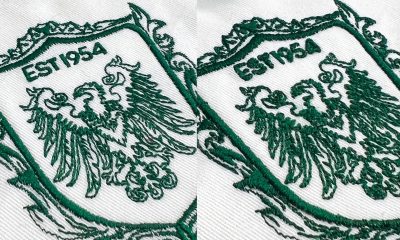
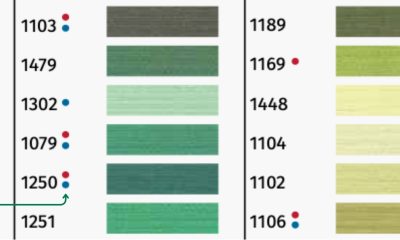
60-weight threads are designed to be easily integrated into existing workflows.With nearly 300 colours of Pantone matched, 60-weight threads, available across our Classic and Polyneon ranges, you can easily switch to suit your design. Simply look for the blue dot on your shadecard to find direct colour matches.
For best results, many embroiderers combine thread weights within a single design, using 40-weight thread for large fill areas and switching to 60-weight for fine details and lettering. This approach maximises coverage where needed while delivering superior definition for the intricate elements.
Available in 1500m cops. Polyneon black & white are also available in 5000m cones.
As branding trends continue to move towards cleaner, more subtle decoration, embroidery designs are becoming smaller and more detailed.
Fine threads are also ideal for lightweight fabrics such as silk, chiffon, performance wear, and fine knits. Because it requires less needle penetration, it helps minimise fabric distortion while producing a smoother, flatter finish. Reduced stitch bulk also improves the overall feel of the garment, particularly in high-density embroidery areas.
Integrating 60-weight threads into your workflow is straightforward. In most cases, machines can continue running with standard settings and little to no adjustment to digitising.
65 SAN® 1 needles provide a strong, versatile choice to keep in your machines at all times, helping reduce the need to change needles when switching threads. It offers strength comparable to a 75/11, while its finer size supports both 40 and 60-weight threads.
For those hesitant to commit fully, there is a simple, low-risk starting point. Start by converting one needle position per head, often the 15th needle, to a finer needle and keeping a 60 permanently threaded, operators can instantly improve the most critical elements of many designs. This approach saves time, reduces rethreading, and delivers immediate visual improvements, a simple upgrade with a lasting impact.
For businesses focused on quality, detail, and brand presentation, Madeira 60-weight thread offers a clear advantage. By refining the smallest elements of your embroidery, you can deliver results that stand out in a competitive market.
© Madeira 2026